
Views: 0 Author: Site Editor Publish Time: 2026-09-05 Origin: Site


Riding a motorcycle is an inherently visceral experience. The crisp wind against your face and an entirely unobstructed field of vision connect you directly to the asphalt. However, from an engineering perspective, choosing the right protective gear is a precise science of kinetic energy management and aerodynamic stability. For many riders, an open-face riding helmet offers the purest way to experience the journey, successfully bridging the gap between maximum ventilation and critical impact protection.
Recent industry trend analysis reveals a significant shift in motorcycle safety gear preferences. As urban congestion intensifies and global summer temperatures rise, market data indicates a 35% year-over-year increase in demand for hybrid urban commuting gear. Motorcyclists are actively pivoting away from restrictive, heat-trapping full-face options for lower-speed riding. Instead, they are demanding highly ventilated 3/4 designs equipped with modern smart-communication capabilities and advanced composite shells. Yet, with a saturated market, selecting a model that genuinely protects your skull without causing aerodynamic drag can feel overwhelming.
This comprehensive guide strips away the marketing fluff. Relying on objective safety data, material science, and ergonomic principles, we will walk you through the exact standards engineers use to evaluate helmet performance. You will gain the foundational knowledge required to confidently select the optimal gear for your specific operational needs.
Vehicle Alignment: Your gear must match your machine's aerodynamic profile. A scooter commuter requires vastly different visor mechanics than a heavy cruiser.
Safety is Absolute: Impact protection is non-negotiable. Always verify DOT (FMVSS 218) or ECE 22.06 certifications.
Fit Dictates Performance: Identifying your specific cranial shape (round, oval) prevents painful pressure points and dangerous high-speed lift.
Youth Engineering: Passenger safety requires specialized weight distribution. Kids' helmets must use lightweight shells to prevent cervical spine fatigue.
Before investing in new gear, we must validate that a 3/4 shell actually aligns with your daily riding environment. The open-face helmet occupies a highly specific middle ground in the protective spectrum. It shields the parietal, temporal, and occipital lobes of your skull while leaving the facial structure exposed for maximum airflow.
How does it stack up against other options? Let's look at the hard data.
Helmet Category | Coverage Area | Aerodynamic Drag | Ideal Riding Scenario |
|---|---|---|---|
Open-Face (3/4) | Top, sides, and rear skull | Moderate (best under 65 mph) | Urban commuting, cruisers, touring |
Full-Face | Entire head and jawline | Low (optimized for high speed) | Track racing, highway touring, sport bikes |
Half-Helmet (Shorty) | Crown of skull only | High (prone to lifting) | Low-speed neighborhood cruising |
Furthermore, when comparing a 3/4 design to a half-helmet, the safety upgrade is substantial. Half-helmets lack lateral coverage. In contrast, open-face helmets extend down the sides, gripping the cheeks and jawline. This extended surface area provides superior aerodynamic stability, drastically reducing the tendency of the helmet to pull backward when you accelerate.
Motorcycle gear is not one-size-fits-all. The functional requirements of navigating downtown gridlock differ vastly from crossing state lines on a bagger.
For riders navigating dense urban environments on scooters, convenience and peripheral visibility are the ultimate priorities. Commuters should focus on injected polycarbonate designs featuring wide, optically correct flip-up visors. A full-length face shield protects delicate facial skin from kicked-up street debris and exhaust particulates while allowing instant communication at traffic lights.
Conversely, cruiser riders traditionally favor a minimalist, retro-styled profile that visually complements raw V-twin engines. These helmets often omit the integrated face shield entirely. Instead, riders pair them with impact-rated goggles. This setup effectively manages wind deflection while maintaining a classic silhouette.
Touring involves long hours in the saddle at sustained speeds. Touring-focused open-face helmets must prioritize acoustic dampening and multi-density plush liners to prevent pressure fatigue. Additionally, integrated recesses for communication system speakers are mandatory for GPS navigation.
Visual appeal must always remain secondary to verified structural integrity. A helmet is a life-saving kinetic energy management device. Safety relies entirely on a two-part system: the rigid outer shell and the crushable inner liner.
The outer shell prevents sharp penetration and distributes the initial impact force. Entry-level models use ABS or Polycarbonate, while premium tiers utilize Fiberglass or Carbon Fiber for superior strength-to-weight ratios. Beneath this sits the EPS (Expanded Polystyrene) liner. During a crash, the EPS compresses permanently to absorb kinetic energy, preventing it from reaching your brain.
Always inspect the certification stickers permanently affixed to the lower back exterior of the shell. DOT (FMVSS 218) is the foundational legal standard in the United States, ensuring the helmet can absorb a baseline threshold of impact energy. The newer ECE 22.06 standard is widely considered more rigorous, involving multi-point impact testing and rotational force measurement.
When outfitting young passengers, standard adult scaling rules are dangerously obsolete. Children possess developing physiology; their neck muscles cannot support heavy loads under deceleration. Placing a heavy, adult-sized extra-small helmet on a child can cause severe cervical spine fatigue or whiplash during sudden braking.
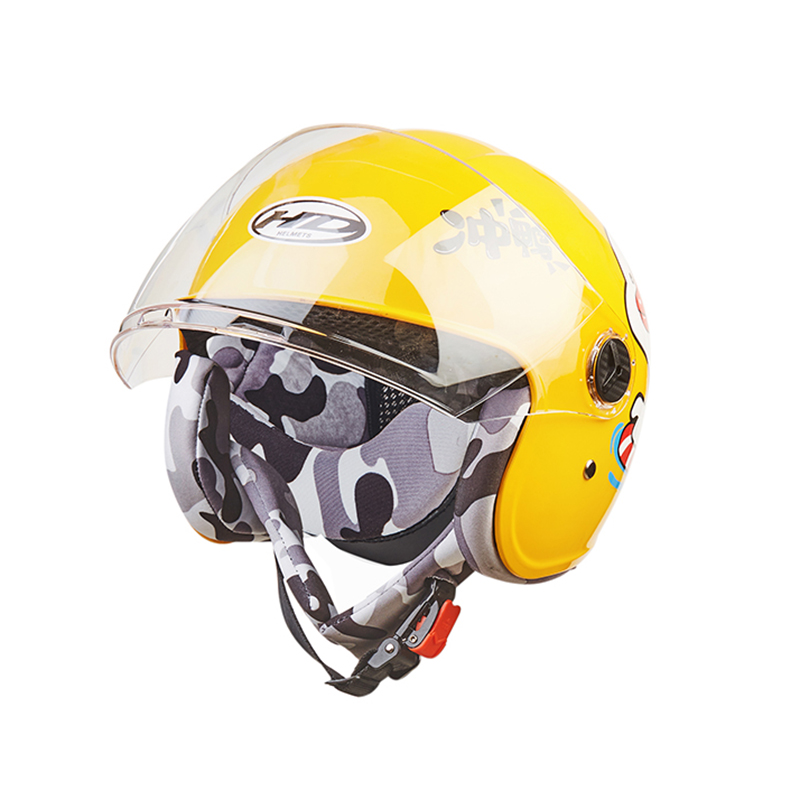
Youth gear must be engineered from the ground up. For example, precision-engineered products like the Kids Lovely Cartoon Design Open Face Riding Helmet utilize a highly specific construction. By utilizing an advanced, lightweight ABS shell, the total weight is kept strictly under 950 grams. This drastically reduces neck strain. Furthermore, it incorporates high-density EPS foam tailored for lighter body weights, a quick-release micrometric buckle for easy operation by small hands, and a scratch-resistant PC visor.
Beyond the technical specs, encouraging children to wear safety gear consistently depends heavily on visual appeal. Vibrant, engaging graphics ensure the child actually wants to wear their protective equipment, making safety a frictionless part of the family ride.
Even a carbon-fiber shell is rendered ineffective if it does not fit your specific cranial anatomy correctly. A loose helmet will violently rotate upon impact. A tight helmet restricts blood flow, causing severe headaches and distracting the rider.
Never rely on generic clothing sizes (S, M, L). Grab a soft, flexible tailor’s measuring tape. Wrap it horizontally around your head, approximately one inch above your eyebrows. Record the measurement in centimeters. Compare this exact number to the manufacturer’s official sizing chart.
Fitment is a three-dimensional puzzle. You must match your specific head shape:
Round Oval: Nearly as wide side-to-side as it is long front-to-back.
Intermediate Oval: The most common shape, slightly longer front-to-back.
Long Oval: Noticeably longer front-to-back and narrow on the sides.
Wearing a Round Oval helmet on a Long Oval head creates a painful "hot spot" on the forehead and leaves empty space on the sides. At 60 mph, turbulent air enters that empty space, causing dangerous aerodynamic lift that pulls the strap against your throat.
Once structural safety and fitment are established, daily comfort dictates your riding experience. Modern 3/4 helmets incorporate functional features designed to mitigate environmental fatigue.
Rapidly changing light conditions are hazardous. An internal, drop-down sun visor is a critical advancement. Operated via a simple slider, this allows riders to instantly adapt to blinding sun glare without needing to pull over and switch to sunglasses.
Additionally, do not assume an open front eliminates the need for ventilation. Significant body heat accumulates against the scalp directly under the dense EPS liner. Look for actively channeled ventilation systems. Adjustable top intake vents and rear exhaust ports create a Venturi effect, actively pulling hot, moist air out of the helmet channels to keep your head dry.
Proper maintenance preserves both the structural integrity and the acoustics of your protective open-face helmet. Never use harsh household chemicals, glass cleaners, or petroleum-based solvents on the shell. These abrasive substances invisibly degrade the polycarbonate and melt the EPS foam.
The motorcycle industry adheres strictly to the "5-Year Rule." Natural hair oils, constant UV exposure, and environmental temperature fluctuations cause the EPS liner to harden over time. It loses its vital shock-absorbing properties. Regardless of a pristine outward appearance, a helmet should be retired five years from its date of first use.
Most importantly, if your helmet sustains a crash or is dropped onto concrete from handlebar height, it must be replaced immediately. EPS is a single-use material; once compressed, it will not expand back, leaving that specific section of your skull completely unprotected.
Selecting the optimal riding gear is an exercise in balancing your personal aesthetic with uncompromising, data-backed safety. By taking the time to accurately measure your head shape, prioritizing multi-density EPS construction, and verifying DOT or ECE certifications, you ensure your gear performs when kinetic energy management matters most.
An open design connects you directly to the environment, offering an unmatched sensory experience. Evaluate your daily commuting speeds, set a realistic budget for advanced composite materials, and never compromise on a snug, aerodynamic fit. Ready to upgrade your ride? Explore the highly engineered, rigorously tested brand and products from https://www.huadunhelmet.com to find your perfect match today.
Yes, provided they carry verifiable DOT or ECE certifications. However, engineers caution that they inherently lack the rigid chin bar of a full-face model. At sustained highway speeds (above 65 mph), they expose the rider to increased wind fatigue and airborne debris. Equipping the helmet with a full-length, shatter-resistant PC face shield is highly recommended for highway travel to deflect rocks and insects.
Aerodynamic instability, often felt as upward lift or buffeting, typically begins to manifest between 55 and 65 mph, depending on the helmet's shell design and the presence of a windshield on the motorcycle. Ensuring a precise fit tailored to your specific head shape (e.g., intermediate oval) drastically reduces this lift by preventing turbulent air from entering the sides of the helmet.
No. The degradation timeline for all motorcycle helmets is dictated by the breakdown of the internal EPS foam and comfort liners, not the outer shell style. Both open-face and full-face helmets adhere to the industry-standard 5-year replacement rule from the date of first use, or 7 years from the manufacturing date, due to UV exposure, sweat, and natural oil accumulation.
Absolutely. Due to the lack of a restrictive chin bar, 3/4 helmets are generally the easiest type of protective headgear to pair with prescription eyewear. When selecting a model, look for "eyewear-friendly" EPS designs. These feature specific channels cut into the interior cheek pads to accommodate the arms of your glasses without driving them painfully into your temples.
Because the lower jaw area is exposed to turbulent airflow, they are naturally louder than full-face alternatives. The most effective defense against permanent hearing damage is consistently wearing motorcycle-specific, noise-filtering earplugs. Furthermore, choosing a helmet with a long, aerodynamically contoured face shield helps deflect wind smoothly around the sides of your head, cutting down on low-frequency wind roar.


