
Views: 0 Author: Site Editor Publish Time: 2026-09-20 Origin: Site


Riding down a coastal highway with the wind against your skin is the raw experience that draws us to motorcycles. However, from an engineering and safety standpoint, this freedom brings a persistent question: when things go wrong, will a helmet without a chin bar actually protect you? While this style offers unmatched ventilation and a deeply nostalgic aesthetic, it exposes your mandible and lower face to the elements and potential impacts. This guide strips away the marketing fluff. We will examine objective crash data, weigh the practical advantages against the harsh realities of the asphalt, and provide actionable buying advice to help you navigate this crucial gear decision.
Structural Reality: A 3/4 shell provides excellent impact defense for the top, sides, and back of your skull. However, it leaves your chin and jaw completely vulnerable to direct strikes.
Certifications Matter: A legitimate DOT or ECE certification means the helmet has survived rigorous laboratory crush and penetration testing for the specific cranial zones it covers.
Visibility & Airflow: These helmets offer a superior, unobstructed field of peripheral vision and maximum natural airflow. This makes them highly practical for urban commuting, e-mobility, and riding in sweltering heat.
Environmental Drawbacks: Riders must actively mitigate daily hazards. Excessive wind noise, stinging rain, and flying road debris are constant realities when riding without a chin bar.
Smart Selection: Opting for models with modern engineering—such as an integrated double lens system and multi-density EPS—can successfully bridge the gap between open-air comfort and essential facial shielding.
Frequently referred to within the riding community as a 3/4 helmet, an Open-face Motorcycle Helmet is a specific style of protective gear engineered to cover the crown, occipital bone (back), and temporal regions (sides) of the rider's head. It utilizes a hardened outer shell—typically polycarbonate or fiberglass—and a thick energy-absorbing inner liner. In these specific coverage areas, it functions identically to standard full-coverage gear.
The defining structural characteristic is the absolute absence of a chin bar. This intentional design leaves the rider's face exposed to the open air from the brow line down. Riders must rely entirely on secondary drop-down visors or riding goggles for facial shielding.
We design these 3/4 shells to solve a specific problem: maximizing situational awareness and airflow without sacrificing the primary cranial impact zones. It avoids the claustrophobic nature of full-coverage gear while vastly outperforming the minimal protection offered by smaller novelty caps.
It is vital to draw a distinct line between a 3/4 helmet and a half helmet. Half helmets, often dismissed by safety engineers as "brain buckets," sit high on the crown. They only shield the very top of the skull. They offer zero structural defense for the back of the head or the sides. In stark contrast, an open-face design wraps securely around the ears and cradles the base of the skull. When evaluating baseline safety, a 3/4 helmet is vastly superior to a half helmet.
Are they safe? The empirical answer requires a nuanced perspective. Yes, they are highly effective for the specific cranial zones they cover, provided they are properly certified. Nevertheless, wearing one inherently means accepting a calculated risk. You are explicitly trading lower facial impact protection for sensory comfort.
To truly grasp the risks, we must examine objective crash analytics. The Dietmar Otte study, a cornerstone in motorcycle safety research, mapped impact zones on helmets during real-world accidents. The findings revealed a sobering reality: approximately 45% of all impacts in motorcycle crashes occur in the chin and face area. More specifically, the chin bar zone alone absorbs nearly 34.6% of those impacts.
A 3/4 shell lacks a rigid chin bar. Consequently, it offers zero mechanical protection for your mandible, teeth, and lower facial tissue. In the event of a frontal collision where you are thrown forward, your jaw absorbs the kinetic energy. This is the primary, unavoidable safety drawback that every rider must internalize.
Safety is rarely absolute; it is highly contextual. While this helmet style is objectively not the optimal choice for high-speed track days or aggressive canyon carving, it is widely deemed acceptable for lower-risk environments. The enhanced situational awareness—allowing you to hear cross-traffic and see pedestrians clearly—acts as an active safety measure, helping riders avoid the accident entirely in dense urban grids.
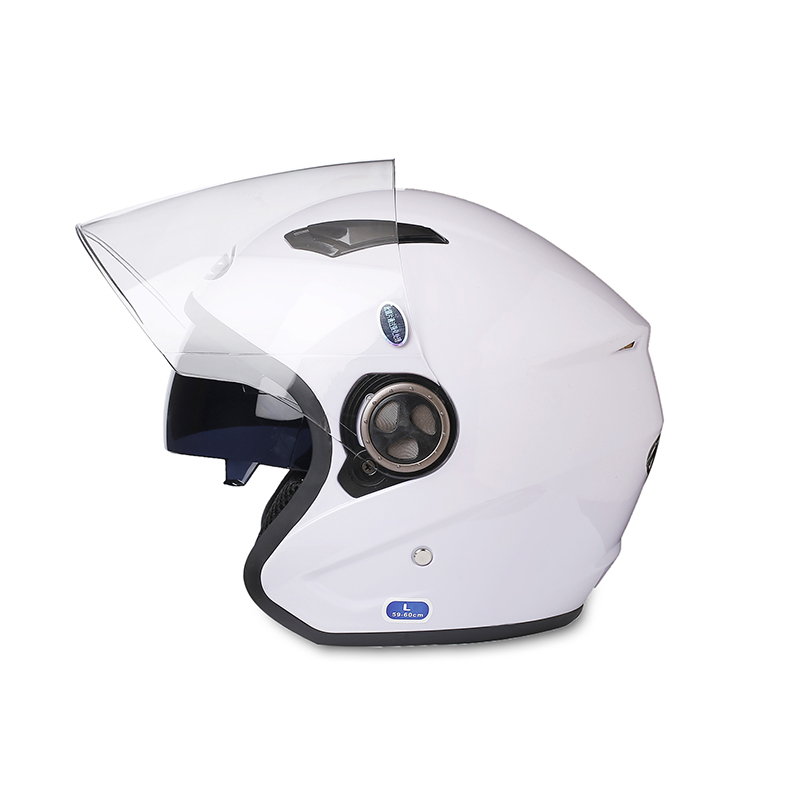
For riders struggling to finalize their gear setup, comparing these two dominant helmet styles across practical dimensions can clarify which option best aligns with your daily riding habits.
Engineering Feature | Full-Face Helmet | Open-Face Helmet |
|---|---|---|
Impact Dispersion | 100% coverage. The chin bar bridges and disperses kinetic energy. | Excellent cranial protection. Zero mechanical chin protection. |
Field of Vision | Can feel restrictive; larger blind spots in peripheral zones. | Unobstructed panoramic vision; excellent for checking blind spots. |
Thermal Management | Relies on small EPS vent channels; prone to heat buildup. | Maximum natural airflow. Ideal for stop-and-go summer traffic. |
Mass & Fatigue | Generally heavier (1500g+), causing higher neck fatigue. | Significantly lighter (often under 1200g), reducing cervical strain. |
A compelling argument for the 3/4 design is active accident prevention. Full-face helmets can occasionally induce a tunnel-vision effect. Open-face helmets strip away these barriers, providing an ultra-wide peripheral view. Furthermore, without thick acoustic padding sealing off the lower jaw, you can clearly hear approaching sirens and subtle engine irregularities.
While the vulnerability of the chin dominates safety discussions, there are several practical drawbacks that riders typically discover only after they hit the highway. Addressing these daily annoyances is essential for a tolerable ride.
Without a streamlined chin bar to deflect turbulent air, wind rushes aggressively past your ears. At highway speeds (exceeding 65 mph), this constant roar easily surpasses 100 decibels. Prolonged exposure to this extreme noise level induces severe mental fatigue and can cause permanent tinnitus. If you intend to ride at highway speeds, high-fidelity motorcycle earplugs are an absolute necessity.
In addition, navigating a sudden rainstorm with an exposed face is a miserable experience. At 50 mph, average raindrops feel like tiny needles striking your skin. Taking a large beetle or a piece of gravel kicked up by a commercial truck directly to the cheek is highly dangerous. The sudden shock can cause a rider to flinch involuntarily, potentially leading to a catastrophic loss of steering control.
Recent market data highlights a massive shift in rider demographics and gear preferences. Historically relegated to vintage cruiser enthusiasts, the 3/4 helmet is experiencing a massive resurgence driven by the explosion of urban micro-mobility. As high-speed e-bikes, electric scooters, and urban commuters dominate city landscapes, riders are demanding gear that offers motorcycle-grade impact absorption without the suffocating bulk of full-face track gear.
In response, the industry is moving away from bare-bones retro caps. The modern trend heavily favors highly engineered commuting tools. Manufacturers are utilizing advanced ABS and composite materials to reduce weight while exceeding stringent safety standards. More importantly, integrated optical technology has become the new baseline, allowing riders to adapt instantly to changing light and weather conditions.
If you determine that the sensory benefits outweigh the structural risks, your immediate next step is guaranteeing the helmet you purchase is a scientifically tested piece of lifesaving equipment. Never compromise by purchasing a "novelty" shell.
Within the United States, an open-face helmet must legally feature a DOT (FMVSS 218) sticker. In European markets, the equivalent standard is ECE 22.06. These certifications ensure the Expanded Polystyrene (EPS) foam liner is engineered to crush upon impact, decelerating your skull at a controlled rate.
To combat the relentless assault of wind, rain, and insects, you should prioritize a helmet with modern, integrated functionality. When evaluating a Double Lens Comfortable Unisex Open-face Motorcycle Helmet, look for these specific parameters to ensure maximum utility and safety:
Dual Optical System: A true double-lens setup is critical. This features an extended, anti-scratch clear outer shield to deflect wind and debris, paired with an independent, retractable inner tinted visor that blocks 99% of UV rays.
High-Density EPS: Ensure the helmet uses multi-density EPS to effectively manage kinetic energy from both low-speed bumps and high-speed impacts.
Ergonomic & Washable Interior: Sweat accumulation is inevitable. The interior lining should feature moisture-wicking, hypoallergenic padding that is fully removable and machine washable to prevent foam degradation.
Retention System: Look for a reinforced micrometric quick-release buckle. It offers exceptional tensile strength while providing urban riders with rapid, stop-and-go convenience.
Choosing to ride with an exposed jaw means accepting a calculated trade-off. To offset these risks, it is imperative to adopt specific defensive habits and supplemental gear strategies.
If you select a minimalist helmet lacking an integrated visor, you must supply your own eye defense. Standard fashion sunglasses are entirely inadequate; gravel will shatter standard glass directly into your eyes. You must utilize shatter-proof, ANSI-rated wrap-around polycarbonate safety glasses.
Furthermore, utilize face masks or heavy bandanas. While a fabric covering will not provide structural impact absorption against the asphalt, it serves as a crucial barrier against environmental hazards. A thick leather mask or a tightly woven bandana drastically reduces the sting of road debris and prevents painful windburn. This enhances overall comfort, especially when utilizing a high-quality Unisex Open-face Motorcycle Helmet.
Ultimately, your most powerful safety feature is your brain. Because you lack the physical barricade of a chin bar, your situational awareness must become your primary defense mechanism. Practice hyper-vigilant scanning at intersections and maintain extended following distances to avoid debris.
Crash data shows that open-face helmets offer exceptional cranial protection and are legally certified to save your life in the zones they cover. However, riders must willingly accept the inherent risks associated with lower facial exposure. They remain an outstanding, highly practical choice for urban commuting, hot weather riding, and e-mobility, provided you understand their mechanical limitations. By choosing a high-quality model equipped with a modern double-visor system, verifying its DOT/ECE certifications, and practicing hyper-defensive riding, you can confidently enjoy the ride while keeping the risks firmly in check. Ready to upgrade your daily commute? Explore engineered, safety-certified Huadun Open-face Motorcycle Helmets to find the perfect balance of ventilation, visibility, and robust impact protection.
Yes, it is legally permissible on the highway, provided it carries the appropriate DOT or ECE certification required by your local jurisdiction. However, from an engineering and practical standpoint, it is not highly recommended for extended interstate travel. Speeds exceeding 65 mph generate extreme wind noise that can lead to hearing damage, and the constant wind drag accelerates physical rider fatigue. If you must ride on the highway, high-quality earplugs and an extended clear face shield are strongly advised.
Yes, all motorcycle helmets have a definitive lifespan. Safety relies heavily on the EPS foam liner. Over time, exposure to ambient heat, UV radiation, and natural degradation causes this foam to harden and shrink, losing its ability to absorb kinetic energy during a crash. Industry consensus strongly recommends replacing your helmet every five years from the date of purchase, or immediately if it is dropped heavily or involved in any crash.
Proper fitment is non-negotiable; a loose helmet will eject during a primary impact. It should fit uniformly snug around the crown of your head, applying firm, even pressure to your cheeks and temples without causing agonizing hot spots. When you shake your head side-to-side, the helmet should not wobble independently of your skin. The retention strap should allow only two fingers to fit between the strap and your chin.
Structurally, they are just as safe in the rain as in dry conditions. However, practically, riding in the rain with an exposed face severely impacts your vision and comfort. Raindrops at 50 mph cause stinging pain and can force a rider to squint, drastically reducing reaction times. If you commute in wet climates, purchasing a model with a long, integrated clear outer shield is essential for deflecting water away from your eyes and upper face.
Yes, they are rapidly becoming the preferred choice for high-speed e-bike riders. Class 3 e-bikes easily sustain speeds of 28 mph, which far exceeds the impact testing limits of traditional foam bicycle helmets. A DOT-certified 3/4 helmet provides the necessary impact absorption required for motorized speeds, while still offering the wide field of vision and superior ventilation necessary to navigate dense city traffic safely.


