
Views: 0 Author: Site Editor Publish Time: 2026-09-10 Origin: Site


Stop-and-go city traffic turns summer commutes into a sweaty ordeal. Picture yourself idling at a sun-baked intersection in mid-July. The heat radiates off the asphalt, and exhaust fumes linger heavily in the stagnant air. Do you really need a bulky, suffocating full-face lid for this? Probably not. An open-face design often solves this daily dilemma.
However, urban streets are highly unpredictable. Car doors open suddenly. Pedestrians step off curbs without a second glance. As helmet engineers, we constantly analyze crash dynamics versus rider comfort. In this technical guide, we will break down the hard safety data, evaluate real-world riding conditions, and highlight the critical engineering features you need to make an informed, confident choice.
Speed Dictates Gear: An Open-Face Riding Helmet is highly effective for low-speed urban commutes (typically under 30 mph). But remember, the kinetic energy involved in a crash increases exponentially as your speed rises.
The Chin Bar Trade-off: You gain unmatched peripheral visibility and superior airflow. The trade-off? Your chin and jaw remain exposed. Crash data shows these areas take a significant percentage of impacts.
Ideal Commuter Profiles: This structural style is perfect for vintage scooter riders, low-speed e-bike commuters, and quick city errands where hyper-awareness of your surroundings is mandatory.
Mandatory Tech Specs: Never compromise on core features. Demand drop-down double visor systems, multi-density EPS foam, and verifiable DOT or ECE safety certifications.
Before diving into helmet structures, we need to look at how city streets are changing. Recent industry analyses reveal a massive shift in urban mobility. Cities are heavily investing in micromobility infrastructure, and the traditional line between bicycle gear and motorcycle safety equipment is rapidly blurring.
Today’s commuters are riding high-performance e-bikes and electric scooters that easily hit 25 to 30 mph. At these speeds, a standard polystyrene bicycle helmet is structurally inadequate. It simply lacks the impact absorption required for motorized accidents. Consequently, market data shows a sharp increase in riders upgrading to certified 3/4 motorcycle helmets. They want intermediate protection—motorcycle-grade skull coverage without the claustrophobia of a track-day helmet.
To make a smart gear choice, you need to understand exactly what is protecting your skull. Let us strip away the marketing jargon and look at the engineering.
Known in the safety industry as a "3/4 helmet," this specific headgear is engineered to cover the crown, occipital lobe (back of the head), and temporal regions (sides). It relies on a rigid outer shell—typically injection-molded ABS, fiberglass, or carbon fiber. Beneath this shell sits the true lifesaver: a thick inner layer of expanded polystyrene (EPS) foam designed to crush upon impact, dissipating kinetic energy before it reaches your brain.
The defining characteristic here is the complete absence of a rigid chin bar. While the helmet wraps securely down over your ears, your lower face remains exposed to the elements. Many modern iterations feature a flip-up polycarbonate face shield to deflect wind, but the structural integrity does not extend across your jawline.
Where does this design sit on the protection spectrum? On the lowest end, you have half-helmets (often called "brain buckets"). These sit solely on the crown of the head. They leave your face, ears, and the base of your skull entirely vulnerable. From an engineering standpoint, they offer the absolute minimum legal compliance and are strongly discouraged for dense city traffic due to zero rear-impact absorption.
Conversely, full-face helmets integrate a solid chin bar. They offer maximum structural protection against blunt force trauma and sliding abrasion. Yet, at 15 mph in heavy traffic, they can feel restrictive, heavy, and overly hot. The 3/4 helmet deliberately strikes a balance. It provides substantially more EPS coverage than a half-helmet while eliminating the enclosed, stuffy nature of a full-face lid.
Choosing a 3/4 lid is not about ignoring safety. For many veteran commuters, it is about optimizing equipment for highly specific environmental challenges.
Urban riding requires constant hyper-vigilance. You need to spot delivery drivers, erratic taxis, and deep potholes instantly. An Open-Face Riding Helmet provides a completely unobstructed field of view. Without a protruding chin bar blocking your downward sightline, you can glance at your instrument cluster or GPS without tilting your head. Furthermore, the lack of side constraints maximizes your peripheral vision, allowing you to detect movement in your blind spots fractions of a second faster.
Heat exhaustion is a massive safety risk. When you are stuck behind a bus at a red light on a 90-degree day, a full-face helmet quickly mimics a sauna. Without forward momentum, aerodynamic air vents simply cannot push air through the EPS channels. This leads to intense sweating, visor fogging, and rider fatigue.
Open-face designs solve this thermal problem inherently. The open front allows ambient air to cool your face continuously, even at a dead standstill. This passive ventilation regulates your core body temperature, keeping your mind sharp and focused on the traffic ahead.
City riding involves frequent stops. You might be grabbing coffee, paying a toll, or talking to a parking attendant. Taking a tight full-face lid off repeatedly is frustrating. An exposed face allows you to communicate clearly without shouting through muffled polycarbonate. In our digital age, it also lets you instantly unlock your smartphone via Face ID when safely pulled over.
To help you weigh the options objectively, let us compare these two dominant styles across core urban commuting metrics.
Feature / Metric | Open-Face (3/4) Helmet | Full-Face Helmet |
|---|---|---|
Lower Face Protection | None (Exposed chin and jaw) | Maximum (Integrated chin bar) |
Field of Vision | Excellent peripheral and downward view | Restricted downward, slight blind spots |
Ventilation | Superior (Passive ambient airflow) | Dependent on speed and internal vent channels |
Physical Weight | Lighter (Reduces neck fatigue in traffic) | Heavier (Can strain neck during constant head-checks) |
Daily Convenience | Easy to talk, use Face ID, or drink water | Muffled voice, requires removal for basic tasks |
While the benefits of superior airflow are undeniable, objective safety data highlights the inherent risks of riding without lower facial protection.
When evaluating crash dynamics, safety engineers consistently refer to the Hurt Report. This landmark study analyzed thousands of motorcycle crashes to map the most frequent impact zones on a rider's head. The data is sobering: roughly 34.6% of all crash impacts occur directly in the chin and jaw area.
Because a 3/4 helmet lacks a chin bar, it offers zero structural defense for your mandible and teeth. If a car pulls out unexpectedly and you are thrown forward over the handlebars, the open-face design leaves the lower third of your head highly vulnerable to blunt force trauma.
If you have decided that an open-face design aligns with your low-speed commute, the next step is procurement. Do not settle for the cheapest novelty shell online. You must evaluate the gear based on strict optical, structural, and comfort metrics.
The absolute baseline for any helmet is independent laboratory testing. A reliable helmet must prove its ability to absorb kinetic energy and resist shell penetration. Look specifically for the DOT (FMVSS 218) certification in the US, or the stringent ECE 22.06 standard in Europe. These stickers guarantee that the EPS foam density meets critical safety benchmarks.
City air is dirty. A commute exposes you to kicked-up gravel, construction dust, and blinding sun glare reflecting off glass skyscrapers. Relying on standard fashion sunglasses is a dangerous compromise, as they are rarely shatterproof.
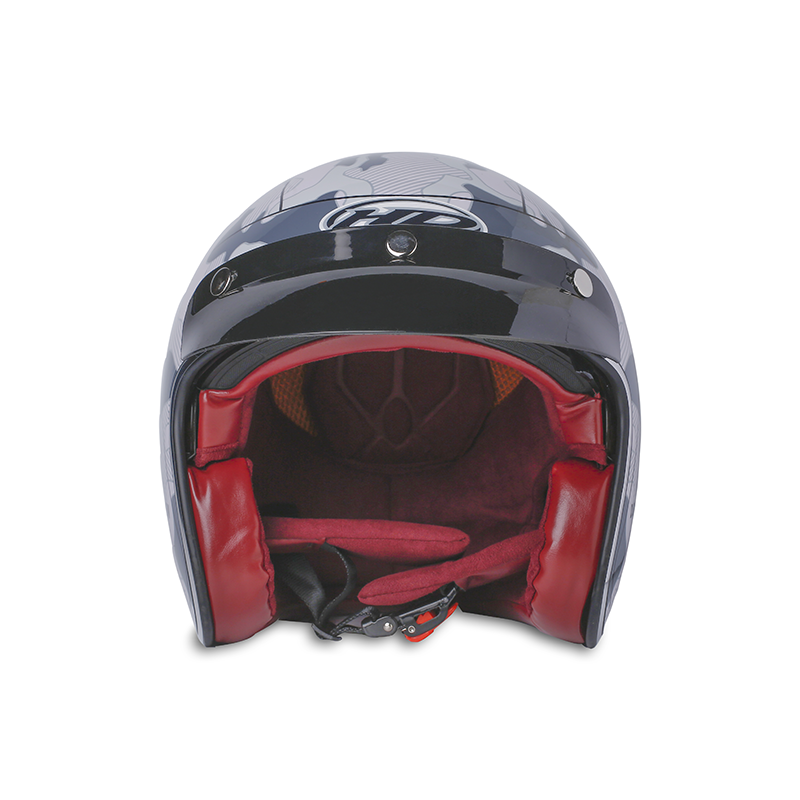
Specifically, you should prioritize a dual-visor setup. For example, the Vintage Double Visor Cozy Comfort Open-face Retro Helmet is engineered with a high-impact, anti-scratch clear outer shield to block physical debris. Simultaneously, it features a retractable, UV-blocking inner sun shield. This mechanism allows you to adapt to rapidly changing light conditions—like riding into a dark tunnel—with the simple flick of a switch.
The micro-environment inside your helmet dictates your daily comfort. During hot summer rides, the interior padding acts like a sponge, absorbing sweat and skin oils. Over time, a dirty interior degrades the protective EPS foam and causes severe skin irritation.
Look for helmets utilizing fully removable, washable, and antimicrobial inner liners. Premium models use laser-cut suede or breathable mesh. This not only makes the gear vastly more comfortable but ensures a snug fit, preventing the helmet from shifting dangerously during hard braking.
Transitioning to a 3/4 setup requires a deliberate shift in your riding psychology and physical preparation.
Because you are consciously sacrificing chin protection, your primary safety strategy must be avoiding the crash altogether. Drastically increase your following distance. That extra space grants you the critical fractions of a second needed to brake smoothly. Always assume turning cars do not see you, and maintain a hyper-aware posture.
In addition, pair your headgear with purpose-built accessories. Even at 25 mph, taking road grit to the cheek is painful. We strongly recommend wearing a tightly woven neck gaiter pulled up over your nose. While fabric will not stop an impact, it serves as an excellent physical barrier against stinging insects, exhaust soot, and biting morning winds.
An open-face helmet is an incredibly viable, comfortable solution for city riding—provided you respect its limitations. It is perfectly suited for low-speed urban commutes, offering glorious airflow and unparalleled peripheral visibility. However, you must accept the lack of lower facial protection and ride defensively to compensate.
Never compromise on build quality. Always demand multi-density EPS foam, a dual-visor system, and washable liners. Ready to upgrade your daily commute? Evaluate your typical route, check your local speed limits, and explore the premium collection of certified open-face riding gear at Huadun Helmet to find the exact setup that matches your urban lifestyle.
Yes, they are entirely legal for street riding in almost all jurisdictions, provided they meet the required regional safety certifications. In the United States, the helmet must feature a legitimate DOT certification sticker on the back. In Europe, it must meet rigorous ECE standards. It is crucial to distinguish between a certified 3/4 helmet and a flimsy "novelty" helmet. Novelty helmets lack the necessary EPS foam layer and offer zero structural protection in a crash.
While there is no strict legal speed limit tied to helmet styles, safety engineers generally recommend 30 mph as the threshold. Below 30 mph, the risk of catastrophic sliding abrasion is lower, making a 3/4 helmet practical for city streets. However, at highway speeds (65+ mph), kinetic energy increases exponentially. Furthermore, a small pebble striking your exposed face at 70 mph feels like a physical blow and can easily cause you to lose control. For highway riding, a full-face lid is the only responsible choice.
Protecting your vision is non-negotiable. The most effective engineering solution is choosing a helmet with a built-in, drop-down visor system. A double-visor setup offers the most versatile protection against wind, debris, and UV glare. If your gear lacks a built-in face shield, you must wear shatter-proof riding goggles or heavy-duty motorcycle sunglasses that meet ANSI Z87.1 impact resistance standards. Standard fashion sunglasses can shatter upon impact, sending glass into your eyes.
Yes, they are highly recommended for modern electric micromobility vehicles. Standard bicycle helmets are tested for low-speed pedal falls (typically under 15 mph). Modern Class 3 e-bikes and electric scooters effortlessly maintain speeds of 20 to 30 mph in heavy traffic. At these motorized speeds, you need motorcycle-grade protection. A certified 3/4 design provides significantly thicker EPS foam and crucial coverage for the sides and back of your skull.
Industry standards mandate replacing your helmet every 3 to 5 years, depending on usage. Even without a crash, the EPS foam inside naturally degrades over time due to UV exposure, heat, and the oils from your hair and skin. Furthermore, if you drop your helmet on concrete from a height of more than a few feet, the internal foam may compress unseen. Once the EPS is compromised, it cannot absorb kinetic energy in a real accident and must be replaced immediately.


