
Views: 0 Author: Site Editor Publish Time: 2026-08-01 Origin: Site


Many people search online for the average female helmet size. You might be a new female rider finding your starting point. Or perhaps you want to buy a surprise gift for a passenger. Finding the correct fitment feels incredibly overwhelming at first. Riders often try guessing their size based on clothing proportions.
Guessing a size based on national averages creates a critical safety hazard. It also guarantees wasted money. An improperly sized helmet offers little protection during a crash. A loose shell cannot absorb impact energy effectively. It will move around and transfer force directly to your skull.
While a statistical average exists, successful buying demands much more effort. You must understand exact head measurements. You need to identify specific head shapes. You also need to consult specific brand sizing charts. Today, we will explore how to secure the perfect fit. You will learn actionable steps to guarantee comfort and safety.
The statistical average motorcycle helmet size for women falls between Small (S) and Medium (M), typically equating to a head circumference of 54cm to 57cm.
Safety standards mandate a precise fit; a helmet that is too large can come off during an impact or cause severe neck fatigue from wind lift.
Head shape (Round, Intermediate Oval, Long Oval) dictates comfort just as much as head circumference.
"Women-specific" helmets often feature identical shell sizes to unisex models but utilize different cheek pad configurations and graphics.
Never buy a helmet as a surprise gift without an exact measurement; utilize interchangeable cheek pads if buying a communal passenger helmet.
Industry data provides a clear statistical baseline for shoppers. Retailer sizing charts show distinct trends among female riders. The average adult female head circumference measures roughly 54 to 57 centimeters. In imperial units, this equals 21.25 inches to 22.5 inches. This baseline gives beginners a helpful starting reference point.
We can easily map this average circumference to standard manufacturing sizes. Across most global markets, these measurements align directly to a Small (S) or Medium (M). Many top-tier manufacturers design their most popular shell sizes around this specific range. However, standard sizing charts vary significantly across different regions.
Here is how average head measurements typically translate into standard helmet sizes.
Circumference (cm) | Circumference (in) | Standard Size Equivalent |
|---|---|---|
51 - 52 cm | 20.1 - 20.5 in | XX-Small (XXS) |
53 - 54 cm | 20.9 - 21.3 in | X-Small (XS) |
55 - 56 cm | 21.7 - 22.0 in | Small (S) |
57 - 58 cm | 22.4 - 22.8 in | Medium (M) |
59 - 60 cm | 23.2 - 23.6 in | Large (L) |
Buying the "average" size blindly remains highly dangerous. Head size does not correlate directly to body height. It does not align accurately to body weight either. A petite female rider might require a Large shell. Conversely, a taller rider might fit perfectly into an X-Small. Relying on average metrics creates a false sense of security.
Brand discrepancies complicate the buying process further. A Medium shell from a European brand like AGV fits very differently. It usually runs narrower. A Medium from an American or Japanese brand like Shoei or Bell accommodates different structures. You cannot assume uniform sizing across the industry. Each brand utilizes unique interior molds.
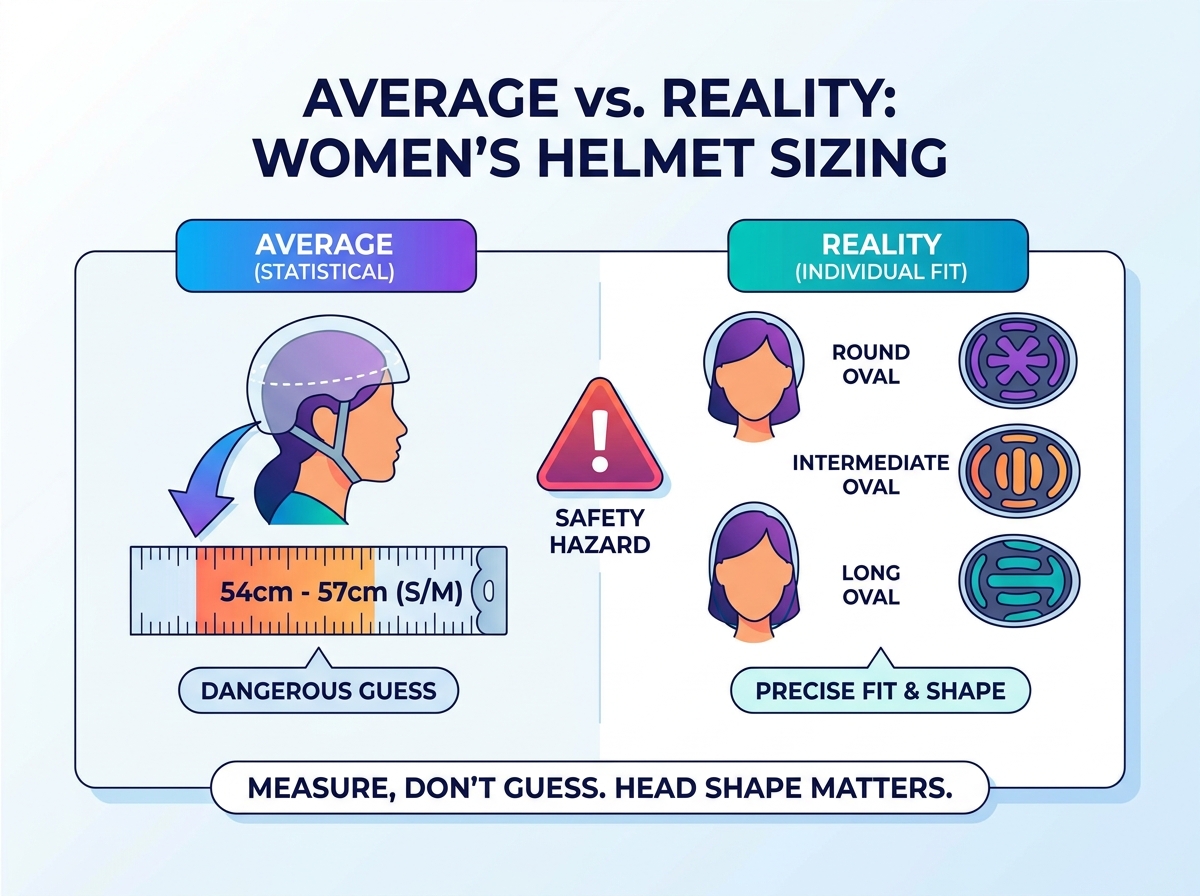
Safety certifications require exact fitment to function properly. Standards like DOT, ECE 22.06, and Snell rigorously test impact absorption. A loose helmet fails to compress the expanded polystyrene (EPS) liner properly. During an accident, excess space allows your head to travel. This gap transfers massive kinetic energy directly to your skull. You lose the crucial deceleration benefit.
Roll-off poses another severe risk during accidents. An oversized shell can rotate violently upon ground contact. It might pull off your head entirely during a slide. Safety testers check strap retention and roll-off limits rigorously. If you guess your motorcycle helmet size incorrectly, you bypass these critical engineering safeguards. Your protective gear becomes utterly useless.
Rider fatigue ruins the everyday riding experience. An oversized helmet invites excessive wind noise inside the shell. Prolonged exposure damages your hearing permanently over time. Extra space also creates severe aerodynamic lift. At highway speeds, the wind pulls the helmet upward constantly. This lift causes intense neck strain and shoulder fatigue.
Consider the massive financial risk involved. Helmets represent high-ticket safety investments. Most reputable retailers refuse returns on worn gear. Strict safety liabilities prevent stores from reselling used protective equipment. If you ride for one hour and discover a loose fit, you lose your money. Proper sizing protects your physical safety and your wallet.
You need proper tools to capture an accurate measurement. We strongly recommend using a soft cloth tailor's measuring tape. If you lack one, use a piece of string and a flat metal ruler. Avoid using stiff metal tape measures. They cannot contour to your skull accurately. Proper tools guarantee precise centimeter readings.
Follow standard operating procedures for measurement placement. Wrap the soft tape horizontally around your head. Place it roughly one inch above your eyebrows. Keep the tape positioned just above your ears. Find the widest, most prominent point at the back of your head. Record this exact number in centimeters for the highest accuracy.
Once you select a shell based on your measurement, evaluate the fit. We use the rule of threes to verify safety.
The Crown: It should feel uniformly snug around the crown without localized pressure points.
The Cheeks: Cheek pads should firmly squeeze the cheeks (the "chipmunk face" effect).
The Movement Test: Grabbing the chin bar and moving it should move the rider's skin and cheeks, not just slide the helmet around the face.
Apply these three rules rigorously before you ride. Wear the gear inside your house for thirty minutes. Watch television or read a book. This gives the interior foam time to warm up. You will quickly notice any painful pressure points. If you feel localized pain, you must evaluate your head shape.
Size measurements only dictate your overall circumference. Head shape dictates your ultimate comfort and safety. The motorcycle industry recognizes three primary head shapes. Understanding these categories prevents expensive purchasing mistakes. You must match your unique cranial structure to the correct manufacturer mold.
Round Oval: This shape is shorter front-to-back. It measures wider side-to-side.
Intermediate Oval: This shape measures slightly longer front-to-back than side-to-side. It remains the most common shape for the North American market.
Long Oval: This shape is noticeably longer front-to-back. It fits very narrow on the sides.
Diagnosing fitment hotspots saves riders immense frustration. Imagine measuring perfectly for a size Small. You wear it and feel a painful red mark on your forehead. Many beginners mistakenly assume they need a size Medium. Sizing up creates dangerous gaps around your cheeks and jawline.
You actually need a different internal shape entirely. If you feel forehead pressure, you require a Long Oval shape. You still need a size Small. Switching to a Long Oval Small removes the pressure point safely. It maintains the crucial snug fit around your cheeks. Never fix a shape problem by buying a larger size.
Marketing departments often obscure real helmet engineering. Shoppers frequently wonder if women-specific models offer superior protection. The truth reveals a different story. The crucial EPS foam usually remains identical to the unisex version. Manufacturers utilize the exact same outer shell molds. Engineering differences rarely exist at the structural impact level.
Real differences typically appear in the interior fitment alone. Some brands alter the internal comfort liner slightly. They often provide significantly thicker cheek pads for women-specific models. These enhanced pads accommodate narrower jawlines effectively. They create a tighter, safer squeeze around the lower face. Graphics and colorways also differ heavily.
Modern equipment sometimes features unique hair accommodations. Engineers understand hair volume affects rider comfort. You might find slight internal contouring inside the EPS foam. Some modern liners feature small gaps or channels. These gaps comfortably fit ponytails or thick braids. This prevents the helmet from tilting forward awkwardly.
We advise buyers to avoid limiting themselves to the women's section. The best protective gear is the one fitting your head securely. The marketing label printed on the box means nothing. Many female riders fit perfectly into standard unisex models. Focus entirely on exact measurements, head shape, and the rule of threes.
Many riders eventually buy a backup passenger helmet. They want to accommodate occasional female riders safely. Guessing a size for an unknown passenger feels incredibly tricky. You cannot take precise measurements beforehand. This creates a difficult compromise between safety and convenience. You must navigate this scenario carefully.
If an exact measurement remains impossible, choose your compromise wisely. Buying an Intermediate Oval shape in size Medium represents the safest bet. This specific shape fits the vast majority of North American riders. A size Medium covers the statistical average head circumference. It offers the highest probability of an acceptable fit.
To improve passenger safety, prioritize models offering interchangeable liners. Buy equipment featuring highly customizable cheek pads. This allows you to swap padding sizes easily. You can upgrade from 30mm pads to 35mm pads in seconds. Thicker pads secure a smaller face safely inside a Medium shell. This flexibility proves invaluable.
Do not forget about hygiene and maintenance. Communal gear absorbs sweat and oils rapidly. Briefly check if the model features fully removable liners. Washable liners keep communal gear fresh over time. Clean pads also maintain their structural integrity longer. This ensures your occasional passengers always enjoy a safe, comfortable ride.
Understanding average sizes provides a helpful baseline for new riders. However, remembering your exact measurement remains your highest priority. "Small" or "Medium" represents the average, but the only acceptable size is your measured size. Guessing incorrectly risks severe injury and wastes your hard-earned money.
Take immediate action before buying your next piece of gear. Grab a soft measuring tape and record your head circumference in centimeters. Identify your specific head shape carefully. Consult the exact sizing chart of the specific brand you intend to purchase. Compare your numbers directly against their official sizing metrics.
Finally, always buy from highly reputable retailers. Choose stores offering generous, no-hassle return policies for unworn gear. This ensures a completely risk-free fitment process. You can wear the gear indoors, verify the fit, and exchange it if necessary. Prioritize proper sizing and enjoy the road safely.
A: No. Measurements should be taken flat against the scalp. Hair will compress; sizing up for thick hair results in a dangerously loose helmet once the foam breaks in. Always measure snugly against the skin. Use dedicated liner channels for ponytails rather than buying a larger shell.
A: Yes. The EPS foam doesn't shrink, but the comfort liner and cheek pads will "break in" and compress by 15-20% after 10-20 hours of riding. It should feel borderline too tight when brand new. Never buy a helmet feeling perfectly loose out of the box.
A: If it causes a localized headache within 15-30 minutes of wearing it around the house, or leaves distinct, painful red lines on the forehead, it is either too small or the wrong head shape. Severe pressure points indicate a mismatch with your unique cranial structure.


