
Views: 0 Author: Site Editor Publish Time: 2026-08-08 Origin: Site


Combining prescription glasses or sunglasses inside a snug lid often creates daily frustration. Temple pressure builds quickly. Frames bend easily under stress. Dangerous fogging blocks your view instantly. These common issues ruin otherwise perfect rides. They cause severe headaches. They introduce dangerous distractions on busy roads. You might wonder about finding a definitive solution.
Yes, you can comfortably wear eyewear while riding. You simply must select a motorcycle helmet engineered for this exact purpose. Not all lids share the same internal architecture. Finding the right gear changes your entire riding experience.
We designed this guide to provide an evidence-based framework. You will learn how to evaluate various models properly. We will help you shortlist options effectively. You will also learn how to test fitment thoroughly. This ensures your chosen lid accommodates optical frames flawlessly. You will achieve this goal without compromising critical impact protection. You will maintain excellent aerodynamics throughout your journey. Let us explore the mechanics of a perfect fit.
Not all helmets accommodate glasses; specialized EPS liner grooves are the industry standard for preventing temple pressure.
Modular helmets offer the highest convenience for glasses wearers by eliminating the need to remove frames before donning the helmet.
Modifying a helmet’s internal EPS foam to fit glasses voids safety certifications (DOT/ECE) and compromises crash protection.
Fogging is the primary safety risk; dual-pane visor systems (like Pinlock) or high-flow ventilation are mandatory evaluation criteria.
Helmet trial requires a specific testing sequence to prevent frame distortion and ensure secure eye positioning.
Structural design dictates your daily friction levels. Every rider faces a repetitive mechanical process. You put on your gear. You adjust your vision. You finally ride. Some designs make this sequence seamless. Others create immense frustration every single time. We must analyze how different structural categories impact this routine. Choosing correctly minimizes physical discomfort. It also reduces wear on expensive optical frames.
Modular designs offer unmatched convenience for daily commuters. They feature a hinged chin bar mechanism. You simply flip the front section upward. This allows riders to keep their frames on during the fitting process. You slide the lid over your head easily.
This category has distinct functional advantages. You avoid frustrating blind adjustments. You stop stretching your fragile frame stems. However, we must consider the trade-offs carefully. Modular options weigh slightly more than fixed-chin models. The metal hinge mechanism adds physical mass. They also generate marginally more wind noise at highway speeds.
Full-face models provide maximum structural integrity. They deliver unparalleled safety in crash scenarios. They also offer superior acoustic control. Track riders and high-speed commuters prefer them heavily for these exact reasons.
The primary trade-off involves accessibility. You must remove your frames first. You don the lid tightly. Then, you carefully thread the stems back over your ears blindly. This process requires patience. It often causes temple scratching. It causes bent hinges if rushed. You must adapt to this rigid routine.
Open-face designs guarantee easy eyewear access. Your face remains completely exposed. You simply slide your frames on effortlessly. Many cruiser riders prefer this classic aesthetic for weekend cruising.
The safety risks here remain substantial. These lids lack dedicated chin protection. High-speed wind turbulence vibrates frames violently. This physical shaking blurs your vision at highway speeds. You require secondary eye protection. Goggles or a drop-down visor become mandatory accessories for wind deflection.
Helmet Category | Eyewear Accessibility | Acoustic Control | Overall Safety Profile |
|---|---|---|---|
Modular | Excellent (Keep frames on) | Moderate | High |
Full-Face | Poor (Blind threading required) | Excellent | Maximum |
Open-Face (3/4) | Maximum (Fully exposed) | Poor | Moderate |
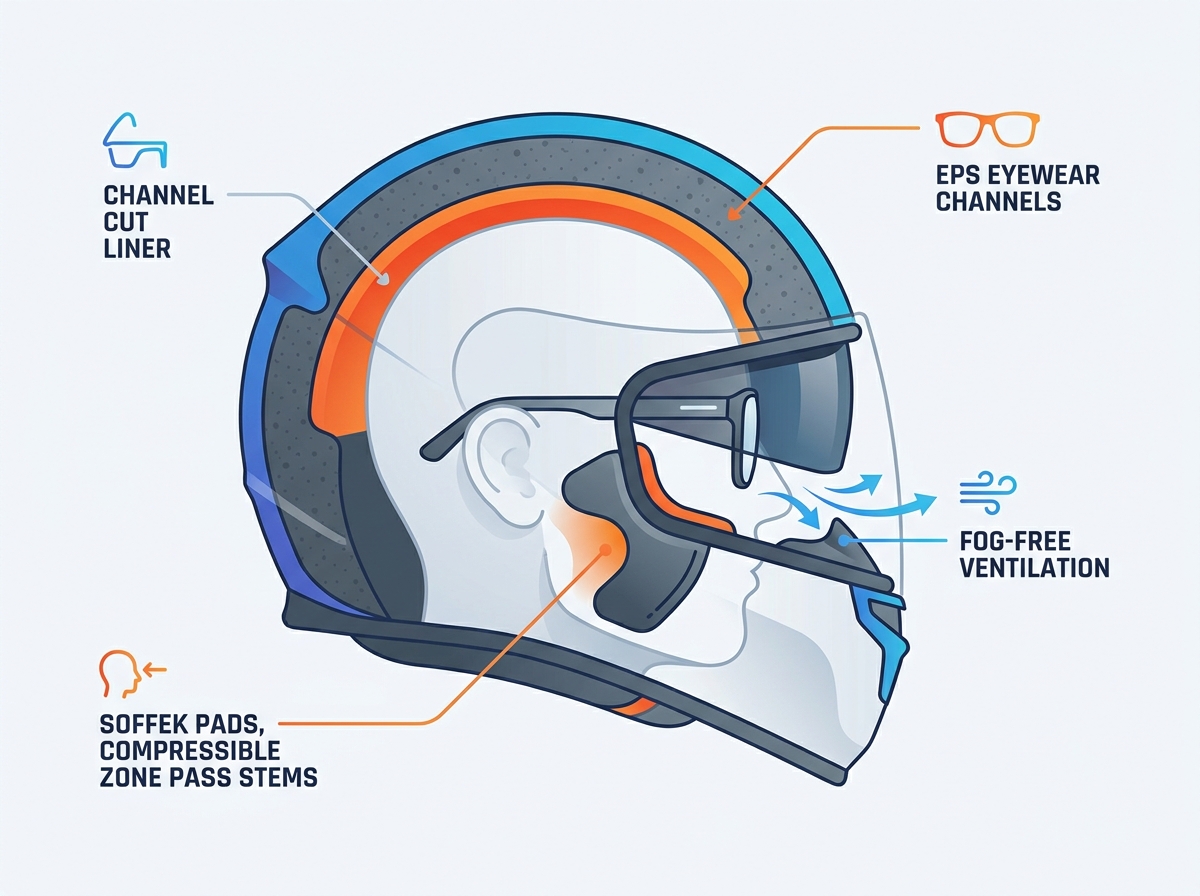
You must evaluate models explicitly featuring internal channels. Manufacturers cut these grooves directly into the Expanded Polystyrene (EPS) foam. This specific feature remains completely non-negotiable for comfort. It relieves lateral pressure along your sensitive temples. Proper channels prevent frames from floating off your nose bridge. A standard motorcycle helmet lacking these grooves will crush your ear cartilage rapidly.
Assess the density of the cheek pads near the top edge. High-quality models utilize dual-density foam here. Firm foam sits lower near the jawline. It seals out turbulent noise effectively. Softer foam sits higher up near the brow. This dual-density approach allows stems to slide in smoothly. You avoid uncomfortable friction against your skin. You gain a quiet ride simultaneously.
Many riders use prescription clear lenses daily. Carrying secondary prescription sunglasses feels tedious. An integrated drop-down sun shield solves this problem instantly. You deploy the tinted shield using an external slider mechanism. This eliminates carrying transition lenses entirely. It provides instant relief from sudden sun glare. You maintain perfect vision through your primary clear lenses.
Prioritize manufacturers known for targeted eyewear engineering. Premium touring lines often standardize specific cutouts. Brand reputation matters significantly here. Do your research before visiting a dealership. Look for proprietary eyewear systems explicitly mentioned in product specifications. Narrowing your choices early saves hours of fitting frustration later.
Trying on a lid requires a precise methodology. Following strict steps prevents frame distortion. It ensures secure eye positioning for maximum safety. Follow this sequence exactly during your evaluation.
Insert your head into the bottom opening evenly.
Settle the interior lining securely against your crown.
Slide your frames straight back along the provided channels.
Check for any immediate ear pinching or hot spots.
Verify your optical center aligns perfectly across your field of view.
Your frame geometry changes everything. Straight-arm sport frames thread easily into narrow spaces. They slide back cleanly along the padding. Traditional hooked-earpiece frames cause serious problems. They often require awkward maneuvering inside the padding. This maneuvering tightens the overall fit uncomfortably. Consider swapping to straight-arm frames specifically for riding purposes.
Perform a simple mechanical test after installation. Look directly into a mirror. Check if the frames sit slightly above your nose bridge. Shake your head side to side gently. Do the frames vibrate? If they vibrate or float, the eye port size is wrong. The cheek pads are incompatible. This specific geometry fails your personal riding needs.
We must explicitly warn against dangerous DIY practices. Never shave or melt internal EPS foam. Some riders attempt creating custom channels at home. This destroys critical energy absorption capabilities immediately. It voids safety certifications like DOT or ECE instantly. A compromised lid offers zero reliable crash protection. Always buy factory-engineered solutions for your own safety.
Eyewear introduces a second thermal barrier inside the enclosure. Your body heat and exhalation create trapped moisture. This makes lenses highly susceptible to rapid condensation. Fogging occurs frequently at lower urban speeds. Cold weather exacerbates this physical reaction significantly. You lose visibility in seconds.
Dual-pane visor systems offer incredible optical clarity. A Pinlock insert prevents the main shield from fogging. However, riders often misunderstand its limitations entirely. A Pinlock does not stop your optical frames from fogging. You still need active internal airflow. Evaluate lids boasting superior chin-bar venting. High-flow vents clear internal moist air rapidly before condensation forms.
Assess the inclusion of a dedicated breath guard. Manufacturers usually mold these from flexible rubber. They sit directly over your nose bridge. The guard physically directs warm exhalation downward. It pushes moisture away from your optical lenses. This mechanical deflection improves visibility dramatically during cold morning commutes.
You must weigh temporary fixes against permanent structural airflow. Chemical anti-fog sprays coat your prescription lenses temporarily. They work decently for short rides. However, sprays wear off quickly. They require constant reapplication before every trip. Permanent mechanical solutions perform much better. A properly ventilated motorcycle helmet solves the root cause permanently.
Off-road adventures demand entirely different gear. Adventure or motocross riding involves dust, mud, and heavy physical exertion. Standard frames become highly impractical here. They bounce around aggressively and collect dirt. Evaluate rugged goggles instead. Many premium goggle manufacturers offer custom RX inserts. These inserts snap securely behind the main goggle lens. They provide perfect vision off-road.
Many modern riders install Bluetooth communication systems. You mount flat speakers inside internal ear pockets. You must ensure these speaker pockets do not overlap the EPS grooves. Poorly placed speakers push aggressively against the frame stems. This pinches the back of your ear severely. Always test speaker placement alongside your frames before finalizing the installation.
Evaluate the long-term financial logic carefully. Premium gear requires a larger initial investment. However, an engineered model saves money eventually. Bent prescription frames cost hundreds of dollars to replace. Ill-fitting lids crush delicate hinges repeatedly. Upgrading your headgear protects your expensive eyewear. It improves your physical comfort exponentially over thousands of miles.
Finding the right gear requires careful consideration. You must align three specific variables perfectly. Your head shape, the lid style, and your frame geometry must cooperate. Ignoring any single factor leads to inevitable discomfort.
We highly encourage an in-person fitting session. Bring your actual riding frames to a local dealership. Do this before committing to any online purchase. Trying things on physically reveals hidden pressure points immediately. It saves you from frustrating return shipping processes.
Our final recommendation remains straightforward. Start your evaluation process by testing modular designs. Seek out models featuring dedicated EPS eyewear channels. This strategy minimizes daily friction. It maximizes your riding focus. Clear vision and supreme comfort guarantee a much safer journey ahead.
A: No, wearing tinted lenses at night poses severe safety risks. Most jurisdictions legally prohibit tinted eyewear after dusk. Tinted lenses reduce low-light visibility dramatically. They hide road hazards and diminish depth perception. Always carry clear prescription lenses for evening rides to maintain legal compliance and personal safety.
A: Yes, many riders prefer contact lenses. They eliminate frame pressure entirely. However, they introduce a different challenge. High-speed airflow entering the vents dries out your eyes quickly. This causes severe irritation on long rides. You must keep your visor fully closed or use hydrating eye drops frequently.
A: No, proper frames do not compromise safety. You maintain full protection if you choose factory-engineered gear. The manufacturer specifically designs EPS grooves to accommodate stems safely. The safety seal remains intact around your face. Never modify the internal foam yourself, as DIY alterations destroy impact resistance instantly.
A: We recommend straight-arm sport frames. They feature flexible, unhooked temples. They slide effortlessly into internal padding grooves. Rigid, hooked earpieces catch on fabric and foam. They bend easily during insertion. Flexible titanium or TR90 memory plastic frames offer the highest durability and comfort for daily riding.


